All-in-One HRMS vs Multiple HR Systems: Which Works at Scale?
Most HR departments in large organisations did not choose their software stack. They inherited it. A recruitment tool was bought when hiring peaked, an attendance system came with the biometric devices, payroll lives in a spreadsheet or an old local system, and the employee file sits in a database that nobody wants to touch. Each piece works on its own. The problem shows up between them.
At some point, usually around the thousandth employee or the third factory, someone asks whether the company should replace all of this with one all-in-one HRMS, or keep the separate systems and connect them better. The question sounds technical. It is really a question about who owns the employee record, how much manual work the organisation is willing to pay for every month, and how quickly HR needs answers.
This article sets out the trade-offs plainly. It looks at what a connected lifecycle actually means, what a best-of-breed stack costs beyond licences, where the data ends up, what reporting looks like in each model, and the cases in which keeping a separate system is still the right call.
What "one connected lifecycle" actually means
An employee's relationship with the company follows a fixed sequence. A candidate is sourced and interviewed. On hiring, the candidate becomes a personnel record with a contract, a grade, a position and a manager. That record drives attendance rules: which shift calendar applies, which devices the employee may punch on, which overtime rate is due. Attendance produces the variables that payroll consumes: worked hours, overtime, shortages, unpaid leave. Payroll produces payslips, bank files and insurance and tax figures. Later, appraisals, development plans and promotions change the record again, and the cycle continues until end of service.
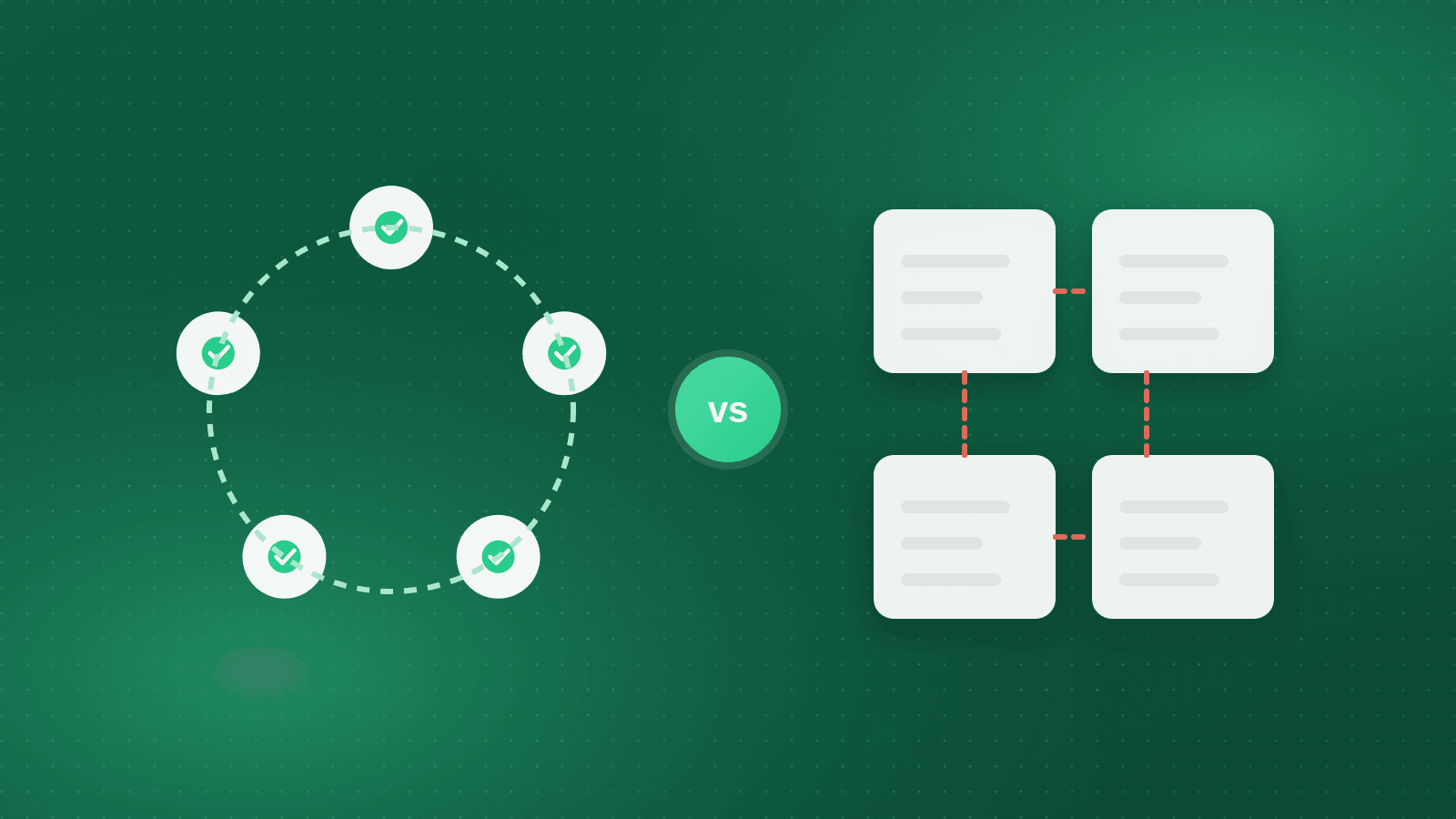
In an all-in-one HRMS, that sequence runs on one employee identifier and one database. The hire creates the personnel record without re-entry. The shift assignment references the same position and location that payroll uses for cost allocation. The overtime calculated at month end is posted to the pay run without anyone exporting a file. The appraisal outcome sits on the same record as the salary history. Every step reads what the previous step wrote.
In a multi-system stack, the same sequence exists, but each handoff is a boundary. Something must carry the new hire from the applicant tracking system into the HR database, carry the shift roster into the attendance system, carry attendance totals into payroll, and carry payroll results back into finance and into the employee's view. Each boundary is either an integration that somebody builds and maintains, or a person who does it by hand.
The real cost of a best-of-breed stack
The licence comparison is the least important part of the cost analysis. Separate systems usually look cheaper on paper because each one is priced for a narrow job. The cost sits elsewhere: in the integrations, in the reconciliation work, and in the errors that reach employees.
Integrations are rarely a one-time expense. Each vendor updates on its own schedule. A field renamed in the attendance system breaks the export to payroll. A new grade added in the HR database does not appear in the recruitment tool until someone remembers to add it there too. Organisations with in-house IT teams can absorb some of this; organisations that rely on external consultants pay for every change and wait for every fix.
Reconciliation is the hidden monthly cost. When attendance and payroll are separate, someone compares totals before every pay run: headcount in one system against headcount in the other, overtime hours exported against overtime hours imported, new joiners and leavers in both. At a few hundred employees this is a few hours. At several thousand, spread across plants and shifts, it becomes a team's full-time job in the last week of every month, and it is still where most payroll errors are born.
Finally, there is the cost of errors that reach people. A missed shortage, a duplicated overtime line, a leaver still paid for a month: each one becomes a dispute, a correction, a retroactive adjustment and, in a unionised or regulated environment, a compliance record. These costs never appear on any vendor's quote, but they are the reason many CFOs eventually favour consolidation.
Who owns the employee record?
Every system in a stack keeps its own copy of the employee. The recruitment tool has a candidate profile. The attendance system has a badge holder. Payroll has a pay record. The HR database has the official file. When they disagree, and they will, which one is right?
In practice the answer is "whichever one was updated last", which is no answer at all. A transfer entered in the HR database but not in attendance means the employee punches at the new plant and is flagged absent at the old one. A salary change entered in payroll but not in the HR file means the letter HR issues for a bank loan shows the wrong figure. The organisation ends up with several partial truths and no single source.
An all-in-one HRMS solves this structurally rather than procedurally: there is one record, and every module reads from it. That also matters for legal compliance. Egyptian Labour Law 14/2025 requires employers to retain employee records for five years and to keep Arabic contracts in four copies; a single record with its documents attached is much easier to produce on inspection than a trail across four systems. Data ownership also matters in a second sense: when the company decides to leave a vendor, it should be able to take one complete dataset with it rather than negotiating exports from several.
Reporting: from one query to a monthly assembly job
HR directors and CFOs ask questions that cut across the lifecycle. What is the fully loaded cost per department, including overtime? Which plants have the highest absence rate among employees hired in the last year? How many contracts expire next quarter, and what is the end-of-service liability if none is renewed? What is the pay gap between grades after this year's increment?
Each of those questions needs data from at least two of recruitment, personnel, attendance, payroll and performance. In a single system, they are reports or dashboard views, refreshed whenever the underlying data changes. In a multi-system stack, they are assembly jobs: extracts from each system, joined in a spreadsheet by someone who knows which employee identifier maps to which, then checked, then presented. By the time the report is ready, the data has moved on.
This is also where AI-based assistants either work or do not. An assistant that answers questions from the company's own HR data needs that data to be in one place, consistently structured, with the same identifiers throughout. Orgarise, for example, provides a strategic HR assistant and an employee assistant in Arabic and English that answer from the organisation's own data across its modules; that is only possible because the modules share one record.
When separate systems are still the right choice
Consolidation is not always correct, and an honest evaluation should say so. There are several situations where keeping a separate system is reasonable.
The first is a genuinely specialised function with deep requirements the HRMS does not meet. Learning management with large content libraries, complex workforce scheduling for airlines or hospitals, or advanced psychometric assessment are examples. If the specialised tool does something the organisation depends on and the HRMS cannot replace it, keep it, and integrate it at one well-defined boundary.
The second is group structure. A holding company with subsidiaries in different countries and different legal entities may run a corporate HR platform for consolidated headcount reporting while each operating company runs the local system that handles its own payroll rules. The key is to decide which system is the master for which data, and to write that decision down.
The third is timing. A company halfway through a payroll implementation should not start a recruitment replacement at the same time. Sequencing matters more than architecture: the recommended order is usually the employee record first, then attendance and payroll together, then self-service, then the talent modules, with each phase stabilised before the next.
The fourth is a finance-led ERP that already handles the general ledger and cost centres well. There is no need to move accounting into an HRMS; the sensible pattern is for the HRMS to post payroll journals to the ERP, not to replace it.
A practical way to run the evaluation
Start with an inventory. List every system that holds employee data, who administers it, what it feeds and what it is fed by, and how each handoff happens today: integration, file, or re-keying. Most organisations are surprised by the number of manual bridges they find.
Then price the bridges. For each manual handoff, estimate the hours per month and the errors per quarter. For each integration, estimate the maintenance cost and the last time it broke. This gives you a real annual cost of the current stack to compare against consolidation, including implementation.
Next, test the candidate all-in-one platforms on the boundaries, not the features. Ask to see a hire become an employee record. Ask to see a shift change flow into overtime and into a payslip. Ask to see an Arabic contract, an Arabic payslip and an Arabic HR letter generated from the same record. Ask what happens to the data if you leave. A platform that handles the boundaries well will handle the features.
Alex Apparels, a garment manufacturer in Alexandria with around 5,000 employees across several factories in the Amria Free Zone, runs recruitment, personnel and employee self-service on Orgarise, so a hire moves from the applicant pipeline into the employee record with one action, and the employee then sees leave, letters and approvals through the same portal. That is the kind of end-to-end path to test in any demonstration. Orgarise covers the full lifecycle in its modules, in Arabic and English throughout, with typical mid-market go-lives of two to six weeks depending on modules and data; but the evaluation method above applies whichever platform you assess.
Takeaway: decide on the boundaries first
The choice between one HRMS and several systems is really a choice about how many boundaries the organisation wants to maintain and who pays when they fail. Count the handoffs, price them honestly, and keep only the specialised systems that earn their boundary. For the core lifecycle, from hire to personnel file to attendance to payroll to development, one record and one connected flow is almost always cheaper, safer and easier to report on than the sum of its parts.
Frequently asked questions
Does an all-in-one HRMS mean we must replace every system at once?
No. Most organisations move in phases: employee record first, then attendance and payroll together, then self-service and talent. Each phase should be stable before the next starts, and specialised tools can stay connected at a single defined boundary.
How do we know if our current integrations are costing too much?
Count the manual handoffs and estimate hours per month and errors per quarter for each; add the maintenance cost and breakage history for each built integration. If the total approaches the cost of a consolidated platform including implementation, consolidation deserves a serious evaluation.
What should stay outside the HRMS?
Accounting and the general ledger belong in the ERP; the HRMS should post payroll journals to it. Deeply specialised tools, such as large learning content platforms or industry-specific scheduling, can also stay if the HRMS cannot replace them.
What is the biggest risk when consolidating HR systems?
Data migration. Employee files, leave balances, salary history and documents from several systems must be reconciled before go-live. Plan a parallel payroll run and check Arabic documents and payslips against the old outputs before switching over.
Alex Apparels — ~5,000 employees
Egypt's leading apparel exporter scales hiring and a large factory workforce while keeping HR paperless.
~5,000
Employees supported
20M+
Garments a year
Multi-factory
Sites in the Amria Free Zone
See how Orgarise handles this
A 30-minute demo on your own scenario, in Arabic or English.