Choosing HR Software in Egypt: What Enterprise Buyers Should Evaluate
Choosing HR software for an Egyptian enterprise is a different exercise from choosing it for a company in London or Singapore. The core needs are the same: a reliable employee record, accurate pay, attendance that feeds payroll, and reports that leadership trusts. But the rules that sit underneath those needs are specific to Egypt, and a system that handles them loosely will create work rather than remove it.
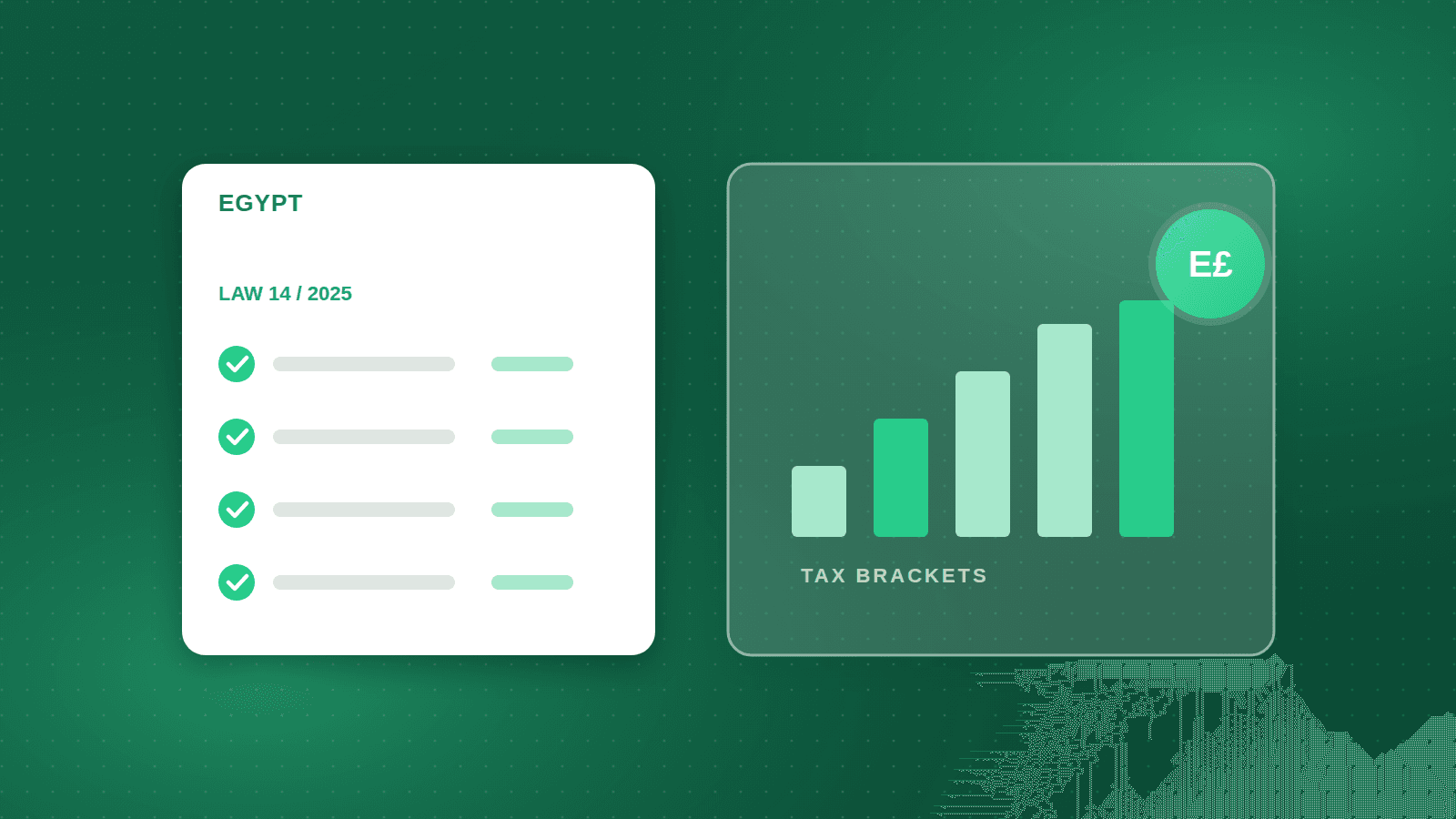
This matters more now than it did two years ago. Labour Law 14 of 2025 has been in force since 1 September 2025, and it changed record-keeping, contract and wage obligations that any HR system has to reflect. Add the progressive income-tax brackets, the social-insurance floor and ceiling, and the working-hour limits, and the list of things a system must get right is long enough to deserve a structured evaluation.
This guide is written for the HR director, CFO or IT lead at an organisation of 500 to 10,000 employees who is responsible for that evaluation. It covers the Egyptian specifics first, then support, implementation and pricing, and ends with a checklist you can adapt to your own tender or shortlist.
Start with the Egyptian rules, not the feature list
Vendor demonstrations tend to open with dashboards and mobile apps; your evaluation should open with the rules. Egyptian payroll is governed by progressive income-tax brackets, and by social-insurance contributions calculated on an insured wage with both a floor and a ceiling. Labour Law 14/2025 adds a mandatory annual increment on the social-insured wage. Ask the vendor to show, on screen, how each of these is configured and what happens when the figures change. If the answer involves a developer or a change request, the system is not localised; it has been patched.
Working time has the same character. The law limits working hours to 8 per day and 48 per week, and a factory with three rotating shifts, night premiums, Ramadan hours and weekend overtime needs a system that knows these limits and calculates overtime and shortages against them automatically, rather than a system that stores hours and leaves the arithmetic to a spreadsheet.
Documents are the third area. Employment contracts must be in Arabic and held in four copies, and employee records must be retained for five years. A system that produces contracts, letters and payslips in Arabic as a native output, not as a translated afterthought, saves real effort here. So does a full change history on every employee record, because a retention rule is only useful if the retained record can show what it looked like on a given date.
Test Arabic as a working language, not a translation layer
Many global suites offer an Arabic interface. Fewer produce Arabic documents correctly, with right-to-left layout, the numerals your company uses, dual calendars where needed, and Arabic letters and payslips that a labour office or a bank will accept without comment. Fewer still allow HR staff to work in Arabic while managers or auditors work in English on the same records at the same time.
The practical test is to ask for a sample contract, a payslip, an experience certificate and a standard HR letter in Arabic, generated by the system from real fields rather than typed. Then ask for the same documents in English. Then ask how a template is changed when the wording needs to differ by grade or entity. If any of these requires the vendor's staff, plan for that dependency in your budget.
Evaluate local support and local knowledge as a product feature
For a global platform, Egypt is one market among many, and Egyptian regulatory changes reach the product roadmap when they reach it. For a system built in Egypt for Egyptian and Gulf employers, those changes are the roadmap. This matters most in the months after a legal change, when your payroll must be correct before the vendor's next release cycle.
Ask specific questions. Who handles support, in which language, and in which time zone? When Labour Law 14/2025 came into force, how long did it take the vendor to release the corresponding configuration or update, and what did customers have to do themselves? Can the vendor name customers in Egypt of your size and sector who will take a reference call? The answers tell you more than any certification.
Look at implementation as a project you will co-own
Enterprise HR software is not installed; it is implemented, and the customer's share of that work is larger than most buyers expect. Your team will need to supply clean employee data, decide on the organisational structure of entities, positions and grades, define approval chains, and sign off on parallel payroll runs. A vendor that promises a go-live without asking for any of this is either underestimating the work or planning to charge for it later.
Timelines vary with scope. A focused mid-market implementation covering personnel, attendance and payroll can be live in a matter of weeks when the data is ready; a broader scope with recruitment, performance and self-service takes longer. Orgarise, as one reference point, typically goes live at mid-market customers in two to six weeks depending on modules and data. The question to ask any vendor is not how fast, but what they need from you in each of those weeks.
Insist on at least one parallel payroll run before cut-over: the new system and the old method calculate the same month, and every difference is explained. This is the single most reliable test of localisation, because the Egyptian tax and insurance rules either produce the right net pay or they do not.
Ask the pricing questions that matter at your headcount
Cloud HR software in Egypt is most often priced per employee per month, usually in US dollars, with volume bands that reduce the unit price as headcount grows. That is straightforward, but it leaves several questions open. Does the count include workers on unpaid leave, seasonal staff, and employees in notice? How is the price adjusted when headcount moves across a band? Are modules priced separately, and can you start with two and add others later on the same terms?
Ask separately about implementation fees, data migration, training, integration with your finance system or bank, and the cost of additional entities or countries if you operate in Saudi Arabia or the wider Gulf as well. Ask whether an on-premise or enterprise deployment is available if your data-residency or IT policy requires it, and whether that changes the support model. A cloud quote that looks low often becomes comparable only after these items are added.
Learn from organisations that have already made the choice
The most useful evidence in an evaluation is an organisation like yours that has been through it. Giza Cable Industries, a Giza-based manufacturer founded in 1993 with more than a thousand employees across several plants producing cable from low voltage to extra-high voltage, runs attendance, payroll and personnel on Orgarise. That combination is typical for Egyptian manufacturing: biometric attendance devices at each plant, rotating shifts, automatic overtime and shortage calculation posted to payroll, and a single employee file supporting the whole process.
What to look for in such references is not enthusiasm but specifics. How were the attendance devices connected? How long did the parallel payroll take, and how many differences were found? What did the HR team stop doing after go-live? A reference who can answer those questions in detail is worth more than a case study written by the vendor.
The takeaway: an evaluation checklist for Egyptian buyers
Before shortlisting, write down a short list of tests and score every candidate against it. On the rules: progressive tax brackets and the social-insurance floor and ceiling configured rather than coded; the Labour Law 14/2025 annual increment handled; working-hour limits, shifts, Ramadan hours and overtime calculated automatically. On documents: Arabic contracts, letters and payslips generated natively, with English available on the same record, and a five-year change history visible per employee.
On the vendor: local support in Arabic with a named escalation path; an implementation plan that states what you must provide and includes a parallel payroll run; per-employee pricing with band rules, module pricing and implementation fees in writing; and two reference customers in Egypt of comparable size who will talk to you. Write the answers down before the demonstration, not after it.
A system that scores well on all of these will rarely be the one with the longest feature list, and that is the point. The right HR software for an Egyptian enterprise is the one that gets the Egyptian rules right on the first payroll, produces documents the labour office accepts, and leaves your team doing HR rather than maintaining the system.
Frequently asked questions
Does HR software in Egypt need to support Labour Law 14/2025 specifically?
Yes. The law, in force since 1 September 2025, introduced obligations such as a mandatory annual increment on the social-insured wage, Arabic contracts in four copies and five-year record retention. Ask any vendor to show how each is configured in the system rather than handled by a workaround.
Is cloud HR software acceptable for Egyptian enterprises, or should we insist on on-premise?
Both are used. Cloud is usually priced per employee per month and is faster to start; on-premise or enterprise deployments are quoted separately and suit organisations with strict data-residency or IT policies. Decide based on your own policy first, then ask whether the vendor offers both without changing the product.
How long should an HR software implementation take for a 1,000-employee company in Egypt?
It depends on scope and data quality. A core scope of personnel, attendance and payroll with clean data can be live in weeks; adding recruitment, performance and self-service extends the plan. Whatever the vendor promises, insist that the plan lists what your team must deliver and includes a parallel payroll run.
What is the most reliable way to test whether HR software calculates Egyptian payroll correctly?
Run a parallel payroll on real data for one full month and reconcile every difference. Include employees at the social-insurance floor and ceiling, employees crossing a tax bracket, a leaver with end-of-service entitlements and a new hire who started mid-month. If the system handles these without manual adjustment, the localisation is genuine.
Giza Cable Industries — 1,000+ employees
A leading Middle-East cable manufacturer unifies attendance and payroll across its plants on one HR platform.
1,000+
Employees on one platform
LV–EHV
Production lines, low to extra-high voltage
Multi-site
Plants on one attendance calendar
See how Orgarise handles this
A 30-minute demo on your own scenario, in Arabic or English.