Choosing HR Software in Saudi Arabia: Beyond Features and Pricing
Most HR software evaluations in Saudi Arabia start the same way. A shortlist is drawn up, a feature matrix is filled in, and prices are compared per employee per month. The matrix usually ends up with ticks in almost every box, because every serious vendor can claim leave management, payslips and an org chart. The decision then drifts toward price, or toward the brand that sounds safest.
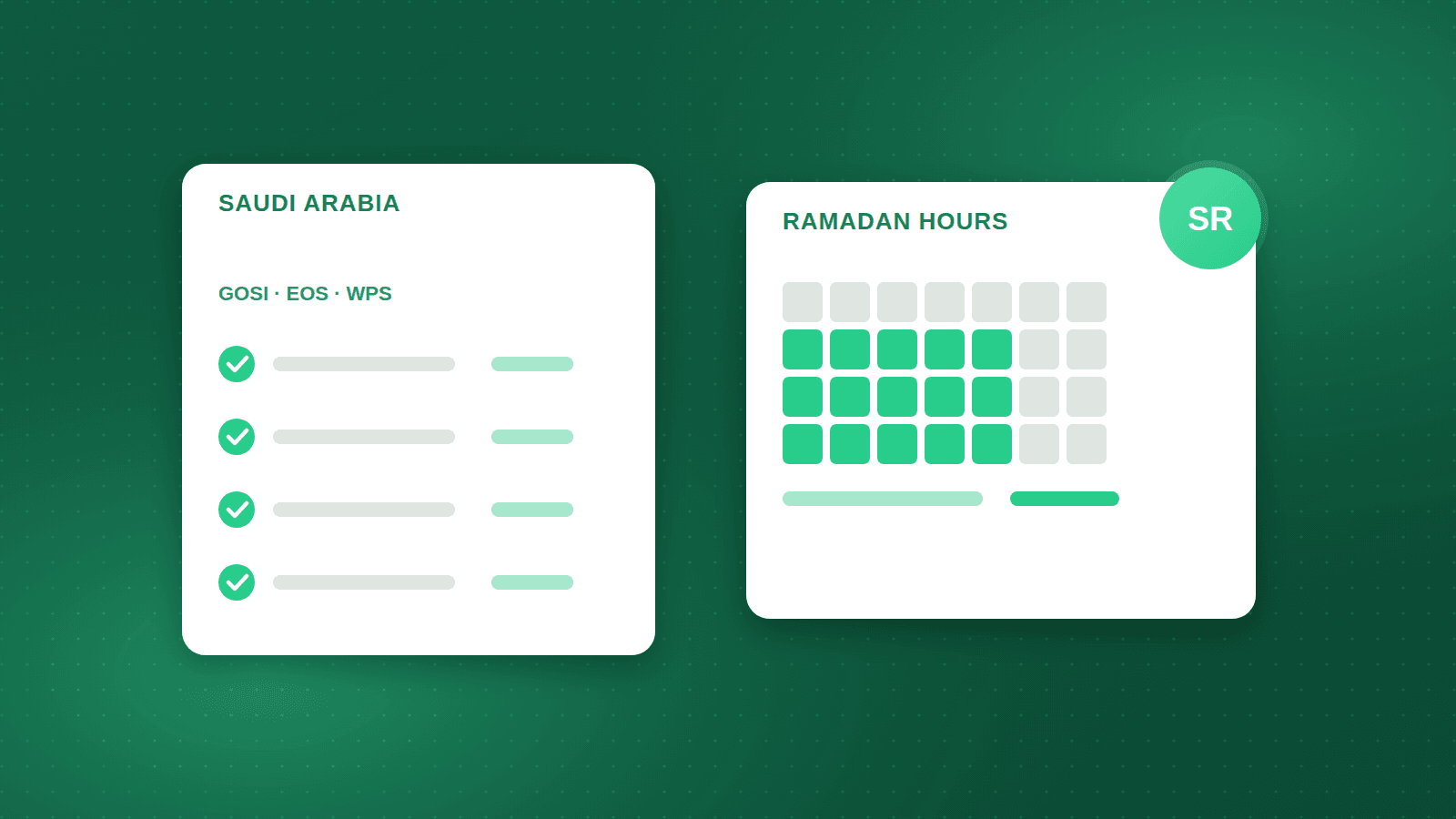
That approach misses the questions that actually decide whether the system works in the Kingdom. Can it calculate GOSI correctly for a Saudi employee and a non-Saudi employee sitting at the same desk? Does it shorten working hours in Ramadan without someone editing every shift by hand? Does it produce the bank file the wage protection process expects, every month, without a spreadsheet in between? Does it warn you before an iqama expires rather than after?
This article is a guide to the evaluation that sits behind the feature matrix. It is written for HR directors, finance leads and IT managers at organisations of a few hundred to several thousand employees, many of them spread across sites, projects and cities. The aim is to help you ask questions that vendors cannot answer with a tick.
Start with the Saudi payroll rules, not the interface
The user interface is what you see in a demo, but the payroll engine is what you live with. In Saudi Arabia the first test is social insurance. GOSI contributions differ by nationality: Saudi and non-Saudi employees are subject to different contribution components, and the rates and covered wage are defined by regulation rather than by your policy. A system that handles this with a single flat percentage field will fail in the first month.
Ask to see how the system stores nationality, how it derives the contribution basis from the salary structure, and how it handles a mid-month change such as a new hire or a salary revision. Ask what happens when the regulator changes a rate. If the answer is "we will send a patch", the rule is hard-coded. If the answer is "you change the rate in the configuration screen with an effective date", the engine is built for local rules.
The second test is end-of-service. The award follows a statutory scale that depends on length of service and the reason the employment ended. A good system accrues the liability continuously so that finance can see it, and then produces the final settlement with the same logic. Ask the vendor to walk through a resignation and a termination for the same employee and show how the two figures differ.
The third test is the bank file. Salaries in the Kingdom are paid through bank files that feed the wage protection process. The file has a defined format, it must match the payroll register exactly, and it is checked. When the HR system cannot produce the file directly, someone exports payroll to a spreadsheet, reformats it and uploads it, and that step is where late payments, mismatches and compliance findings are born.
Ask the vendor to generate a bank payment file from a sample payroll in the demo, in your bank's format. Ask how a correction after the file is generated is handled: is the payroll re-run and the file regenerated, or is the file edited by hand? Ask how retroactive changes, such as a back-dated allowance, are calculated and shown on the payslip. An engine that supports retroactive and net-to-gross calculation removes most of the month-end spreadsheet work.
Ramadan hours, shifts and distributed workforces
Saudi labour regulations reduce working hours for Muslim employees during Ramadan. In an office this is a small change. In a factory, a hospital, a logistics yard or a retail chain running rotating shifts, it changes the length of every shift, the point at which overtime begins, and therefore the pay of thousands of people for a month. Many generic platforms treat Ramadan as a note in the calendar rather than a rule in the engine.
Ask how the system models a shift calendar. Can it define rotating patterns, night shifts that cross midnight, and a separate Ramadan version of each pattern that switches on and off by date? Can it apply the overtime premium automatically once the shortened daily limit is exceeded? Can it calculate shortage, meaning hours worked below the scheduled hours, and post both overtime and shortage to payroll without manual re-entry?
Distributed workforces add another layer. A company with sites in Riyadh, Jeddah and Dammam plus project teams in the field cannot rely on one fingerprint device at head office. Look for a mix of biometric devices at fixed sites and mobile punching with geo-fencing for field staff, all feeding the same attendance ledger. The point is not the hardware; it is that one record of hours flows into one payroll.
Documents, iqamas and the expiry problem
Saudi HR runs on documents with expiry dates: iqamas, work permits, passports, medical insurance, driving licences, professional certifications. Each missed expiry has a direct cost in fines, blocked services or an employee who cannot travel. In a workforce of two thousand people with a majority of non-Saudi nationals, the number of expiries per month is large enough that email reminders and shared spreadsheets stop working.
The employee file should hold every document with its number, issue and expiry dates and a scanned copy, and it should raise alerts to the right person on a schedule you define. Ask to see the expiry report and the alert configuration. Ask whether the renewal can be tracked as a workflow, so that the request, the approval and the updated document are recorded together.
Arabic-first is a requirement, not a preference
Arabic is the language of the labour contract, the official letter, the government portal and, for most of the workforce, daily life. A system that offers Arabic as a translated layer over English data structures tends to produce awkward documents: payslips with mixed text directions, letters that need manual editing, reports whose Arabic headings do not fit. The problem grows with every document type.
Test this in the demo with real content. Enter an Arabic employee name and address and see how they appear on the payslip, the employment letter and the org chart. Ask for a salary certificate in Arabic and one in English from the same record. Check that self-service, including the mobile app, is fully Arabic so that a warehouse worker or a driver can request leave without help. Check that reports export in Arabic to spreadsheets without broken characters.
Data residency, hosting and access control
Where the data lives is now a board-level question in Saudi Arabia. Your evaluation should ask three things plainly: where the production data is hosted, whether an on-premise or private deployment is available if policy requires it, and who at the vendor can access your data and under what controls. Vendors with a clear answer will show you the architecture; vendors without one will change the subject.
Inside the system, access control matters as much as hosting. A multi-entity group needs role-based permissions that separate one subsidiary's payroll from another's, allow a site manager to see only their site, and keep salary data away from people who only approve leave. Ask for an audit trail that shows who changed what and when, on both the employee file and the payroll results.
An evaluation checklist you can reuse
Bring the questions above into a scored list and use it with every vendor in the same order. For payroll: GOSI by nationality with effective-dated rates, end-of-service on the statutory scale, overtime premium, retroactive and net-to-gross calculation, and bank payment files in your bank's format. For attendance: rotating shifts, Ramadan calendars, biometric and geo-fenced mobile punches, and automatic overtime and shortage posted to payroll.
For the employee file: document expiries with alerts, Arabic and English documents from one record, and a full audit trail. For the organisation: multiple legal entities, positions and grades, and approval chains that follow the structure. For the platform: hosting and residency options, role-based access, and an implementation plan with a named team, a data migration approach and a parallel payroll run before go-live.
Weight the items that carry legal or financial risk more heavily than those that are merely convenient. A missing dashboard widget costs you a little time. A wrong GOSI basis costs you a regulator's attention.
Where a locally built HRMS fits
Orgarise, built by United Ofoq with offices in Egypt and Saudi Arabia, was designed around these local rules rather than adapted to them. Its payroll module includes configurable tax and social-insurance engines for Saudi Arabia and the GCC, with GOSI by nationality, end-of-service on the statutory scale, overtime premiums, retroactive and net-to-gross calculation, and bank payment files for the wage-protection process. Attendance supports biometric devices, geo-fenced mobile punches, rotating shift calendars and Ramadan hours, with overtime and shortage posted automatically to payroll.
The system is Arabic and English end to end, including the self-service portal and mobile app, payslips, letters and reports. Salary structures, approval chains and forms are built with designers rather than custom code, so a rate change or a new allowance is a configuration task. Staff Arabia, a Cairo-based HR outsourcing provider that supports more than 33,000 employees across client companies in MENA, Africa and Asia, runs payroll, personnel and self-service on Orgarise and has pointed to geo-fenced mobile punching and improved payroll accuracy as practical results.
The practical takeaway: score the rules before the screens
Choose the vendor that gets Saudi payroll, attendance and documents right in a demo with your own data, in Arabic, with a credible answer on hosting. Features and price still matter, but they come second. A system that fails the local rules will cost more in the first year than any licence discount saves.
Frequently asked questions
Does HR software in Saudi Arabia need to calculate GOSI differently for Saudi and non-Saudi employees?
Yes. GOSI contribution components differ by the employee's nationality, and the rates and covered wage are set by regulation. The system should derive the contribution from nationality and salary structure automatically, and allow rate changes with an effective date without a software patch.
How should an HRMS handle reduced working hours in Ramadan?
Ramadan hours should be a dated version of each shift pattern, not a manual edit. When the Ramadan calendar is active, the daily limit shortens, overtime starts earlier and shortage is measured against the shorter day. Both should post to payroll automatically.
What is a bank payment file and why does it matter for wage protection?
It is the file your bank uses to pay salaries, in a defined format that feeds the wage protection process. It must match the payroll register exactly. An HRMS that generates it directly from the payroll run removes the manual spreadsheet step where mismatches and late payments usually occur.
Can HR data be hosted inside Saudi Arabia or on our own servers?
Ask each vendor where production data is hosted and whether an on-premise or private deployment is offered. Orgarise prices its cloud edition per employee per month, and Enterprise and on-premise deployments are quoted separately, so organisations with residency requirements have an option.
Staff Arabia — 33,000+ employees supported
A leading regional HR-outsourcing provider runs compliant payroll for its clients on Orgarise.
33,000+
Employees supported
Since 2000
HR-services expertise
3 regions
MENA, Africa and Asia
See how Orgarise handles this
A 30-minute demo on your own scenario, in Arabic or English.