Global vs Local HRMS in MENA: What to Actually Compare
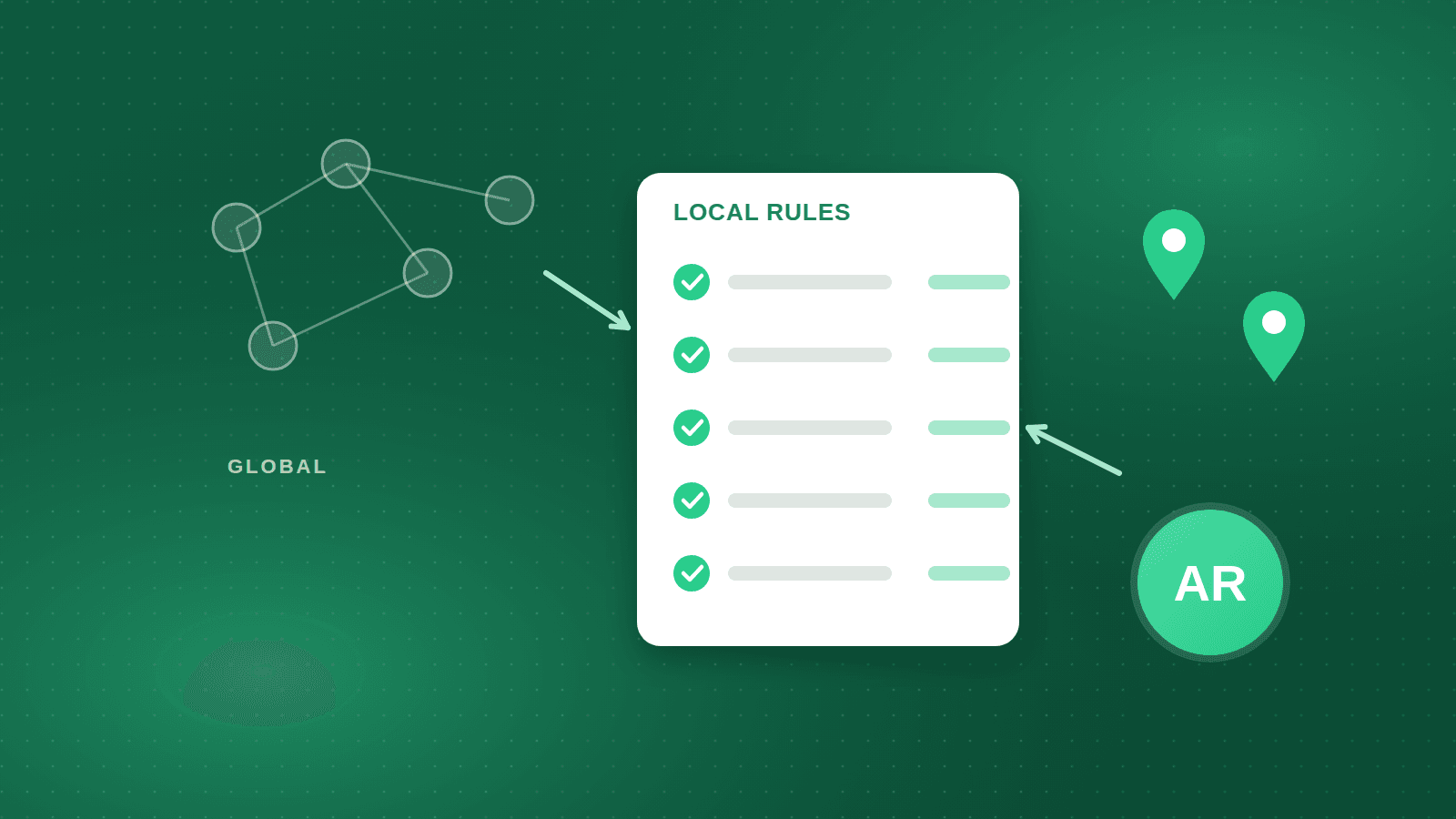
Most HRMS selection projects in Egypt, Saudi Arabia and the Gulf start the same way. A committee collects feature lists from a global suite and from one or two regional systems, builds a scoring sheet, and finds that every vendor ticks almost every box. Personnel records, payroll, attendance, self-service, performance: all present. The sheet does not help, because feature lists describe what a product has, not how it behaves in your country.
The global-versus-local question is real, but it is usually asked badly. Global does not mean better, and local does not mean limited. The useful question is narrower: which system will run your specific payroll, produce your specific documents, mirror your specific organisation and approval chains, and be supported by people who can reach your office, at a total cost you can actually forecast.
This article lays out six things to compare that rarely appear on a feature list, followed by one example of how a regional payroll business ran the comparison. Each item can be tested in a demo or a reference call, and each one is where projects either succeed quietly or fail expensively.
1. Arabic as a working language, not a translation layer
Nearly every serious system can display Arabic labels. That is not the test. The test is whether Arabic is a first-class working language through the whole record: employee names and addresses stored in Arabic and English, contracts and HR letters generated in Arabic with correct grammar and right-to-left layout, payslips readable by a worker who has never used English, and reports that a labour inspector or auditor can read without a translator.
In Egypt this is no longer optional. Labour Law 14/2025, in force since 1 September 2025, requires Arabic employment contracts in four copies and five-year record retention. A system that stores the contract as an attachment generated elsewhere meets the letter of the law but does not help you produce, version and retrieve those documents at scale. In Saudi Arabia, Arabic documents, letters and payslips are the normal expectation of both employees and government bodies.
What to test: ask the vendor to generate an employment contract, an experience letter and a payslip for a sample employee entirely in Arabic, then switch the same user to English. Look at the date formats, the number formatting, the mirrored layout, and whether your own team can change the document template without a change request.
2. Payroll rules: the engine, not the checklist
This is where global and local systems differ most, and where the difference is hardest to see in a demo. Global suites typically deliver payroll in the region through a localisation pack, a partner add-on or an outsourced payroll bureau. Local systems typically build the country engine into the core. Both can work. The questions are who maintains the rules, how fast they change, and who is accountable when a calculation is wrong.
Walk through the actual rules. Egypt: progressive income-tax brackets, social-insurance contributions with an insured-wage floor and ceiling, the annual increment on the social-insured wage that the new law made mandatory, and the 8-hour day and 48-hour week limits that drive overtime. Saudi Arabia and the GCC: GOSI contributions that differ by nationality, reduced Ramadan working hours, the end-of-service award on the statutory scale, the overtime premium, and bank payment files in the format the wage-protection process expects.
Then test the mechanics that HR teams actually depend on: retroactive recalculation when a raise is backdated three months, net-to-gross for an offer letter where the candidate negotiated take-home pay, and a bank file that your bank accepts without manual editing. Orgarise, for instance, builds these into its Payroll module as configurable tax and social-insurance engines for Egypt and Saudi/GCC, with retroactive and net-to-gross calculation, bank files and end-of-service handled inside the same system. Whichever vendor you evaluate, ask to see a retroactive run, not a slide about it.
3. Entities, locations and the shape of your organisation
A 500-to-10,000-employee organisation in MENA is rarely one legal entity in one place. It is a holding company with subsidiaries, factories in a free zone and a head office in the capital, a Saudi branch with its own GOSI registration, and perhaps a sister company in another Gulf state. Each entity has its own registration numbers, its own payroll calendar, its own bank accounts and often its own grading structure.
Global suites are strong on multi-country organisation models in principle, but the model is often designed around large Western enterprises, and the local layers (the Egyptian social-insurance office per entity, the Saudi establishment number, the free-zone rules) end up as custom fields. Local systems usually model these natively but may be weaker if you have entities outside the region.
What to test: build your real organisation in the demo environment. Entities, positions, grades, and the reporting lines that cross them. Ask how an employee is transferred between two entities in two countries and what happens to accrued leave, end-of-service and insurance history. Ask how consolidated headcount and cost reports work across entities with different currencies.
4. Workflow nodes: who approves what, and where the process really lives
HR processes in the region carry more approval steps than most global templates assume. A leave request may need a direct supervisor, a department head and HR. A salary change may need the CFO and the general manager. A recruitment requisition may need a budget check by finance before HR sees it. These chains differ by entity, by grade and sometimes by location.
The comparison is not whether the system has workflow, but how approval chains are built and changed. If every new chain requires vendor developers, you will stop changing them and the process will drift back to email and messaging apps. If HR can build and edit them in a designer, the system stays the system of record. In Orgarise, for example, approval chains, salary structures, appraisal sheets, letters and forms are built with built-in designers rather than custom code. Check also whether approvals work on mobile, because supervisors on a factory floor or a construction site do not sit at desks.
What to test: give the vendor three of your real approval chains, including one with a conditional step (for example, approval by finance only above a certain amount). Watch how long each takes to configure and who does the configuring.
5. Implementation partner proximity
The software is half the decision. The other half is who implements and supports it. Global suites are sold through partner networks; the partner in your city may be excellent, or may be a small team learning the product on your project. Local vendors implement their own product, but you should check how deep their bench is and whether they have handled organisations of your size.
Proximity matters in concrete ways. Time-zone overlap for payroll-day incidents. Someone who can visit a plant to commission biometric devices. Consultants who know the Egyptian social-insurance forms or the Saudi wage-protection file by name and have seen the edge cases. And a support contract written in the language your payroll officers speak.
What to test: ask for two reference customers of similar size in your country and call them. Ask what happened in the first payroll cycle after go-live, how a legal change was delivered, and how long a typical support ticket takes to resolve. For a mid-market organisation, a go-live measured in weeks rather than months is realistic when data is clean and scope is clear; anything promised in days deserves scepticism, and anything quoted in years deserves a question about scope.
6. Total cost including localisation work
Licence price per employee per month is the number everyone compares, and it is the least useful one. The real cost of a global suite in the region often includes the localisation pack, a payroll partner or bureau, custom development for Arabic documents, integration work for local banks and devices, and annual effort to keep local rules current. The real cost of a local system may include integration with global finance tools, extra work for entities outside the region, and a smaller ecosystem of third-party add-ons.
Build a five-year model rather than a licence comparison. Include implementation, data migration, localisation, integration, training, internal staff time, upgrade effort, and the cost of an external payroll bureau if the system needs one. Ask each vendor which items in that list are inside the quoted price and which are not. Cloud pricing is typically per employee per month with volume bands, while enterprise and on-premise deployments are quoted separately; make sure you are comparing the same deployment model.
7. How a regional payroll provider ran the comparison
Staff Arabia, a Cairo-based HR outsourcing and payroll provider operating since 2000, supports more than 33,000 employees across client companies in MENA, Africa and Asia. For a business like that, payroll accuracy is the product itself, and each client is effectively a separate entity with its own rules, calendars and documents. Their evaluation is a useful template: the questions were about entity handling, Arabic documents, calculation accuracy and how field staff record attendance.
They run payroll, personnel and employee self-service on Orgarise, and their own account of the outcome mentions geo-fenced mobile punching and improved payroll accuracy. The point is not the vendor choice but the shape of the decision: a payroll professional compared engines, entities and field operations, not feature counts.
A practical way to run the comparison
Write down the six items above as a scorecard before you see a single demo. For each item, prepare one real scenario from your organisation: a real contract, a real retroactive raise, a real entity structure, a real approval chain, a real reference call, a real five-year cost sheet. Ask every vendor, global or local, to perform the scenario rather than describe it.
A global suite that passes all six is a fine choice. A local system that passes all six is also a fine choice, and often at lower total cost and with a shorter implementation. The system that fails two of them will fail you in the second payroll cycle, whatever its logo. The comparison that matters is not global versus local. It is whether the system behaves correctly in your country, for your organisation, with people nearby who can keep it that way.
Frequently asked questions
Is a global HRMS always more expensive than a local one in MENA?
Not necessarily on licence price, but usually on total cost. The localisation pack, payroll partner, Arabic document work and local integrations are often quoted separately. Build a five-year model that includes them before comparing any two systems.
Can a global suite run Egyptian or Saudi payroll correctly?
Often yes, through a localisation pack or a partner. The questions are who maintains the rules when the law changes, how quickly, and whether retroactive and net-to-gross calculations run inside the system or in a spreadsheet beside it. Ask for a live retroactive run during the demo.
We have entities outside the Middle East. Does that rule out a local system?
Not automatically. Ask the local vendor how they handle entities in other countries: whether payroll rules there are configurable, whether the system can feed a global finance tool, and whether they have customers with a similar footprint. Some organisations run a regional system for MENA entities and integrate it with the group finance system.
How long should implementation take for a 1,000 to 5,000 employee organisation?
It depends on the modules and on data quality more than on headcount. Configurable systems with clean data can go live in weeks for core HR, payroll and attendance; adding recruitment, performance and complex integrations extends that. Be cautious of promises measured in days and of open-ended timelines with no defined scope.
Staff Arabia — 33,000+ employees supported
A leading regional HR-outsourcing provider runs compliant payroll for its clients on Orgarise.
33,000+
Employees supported
Since 2000
HR-services expertise
3 regions
MENA, Africa and Asia
See how Orgarise handles this
A 30-minute demo on your own scenario, in Arabic or English.