HRMS vs ERP HR Module: When HR Needs a Dedicated Platform
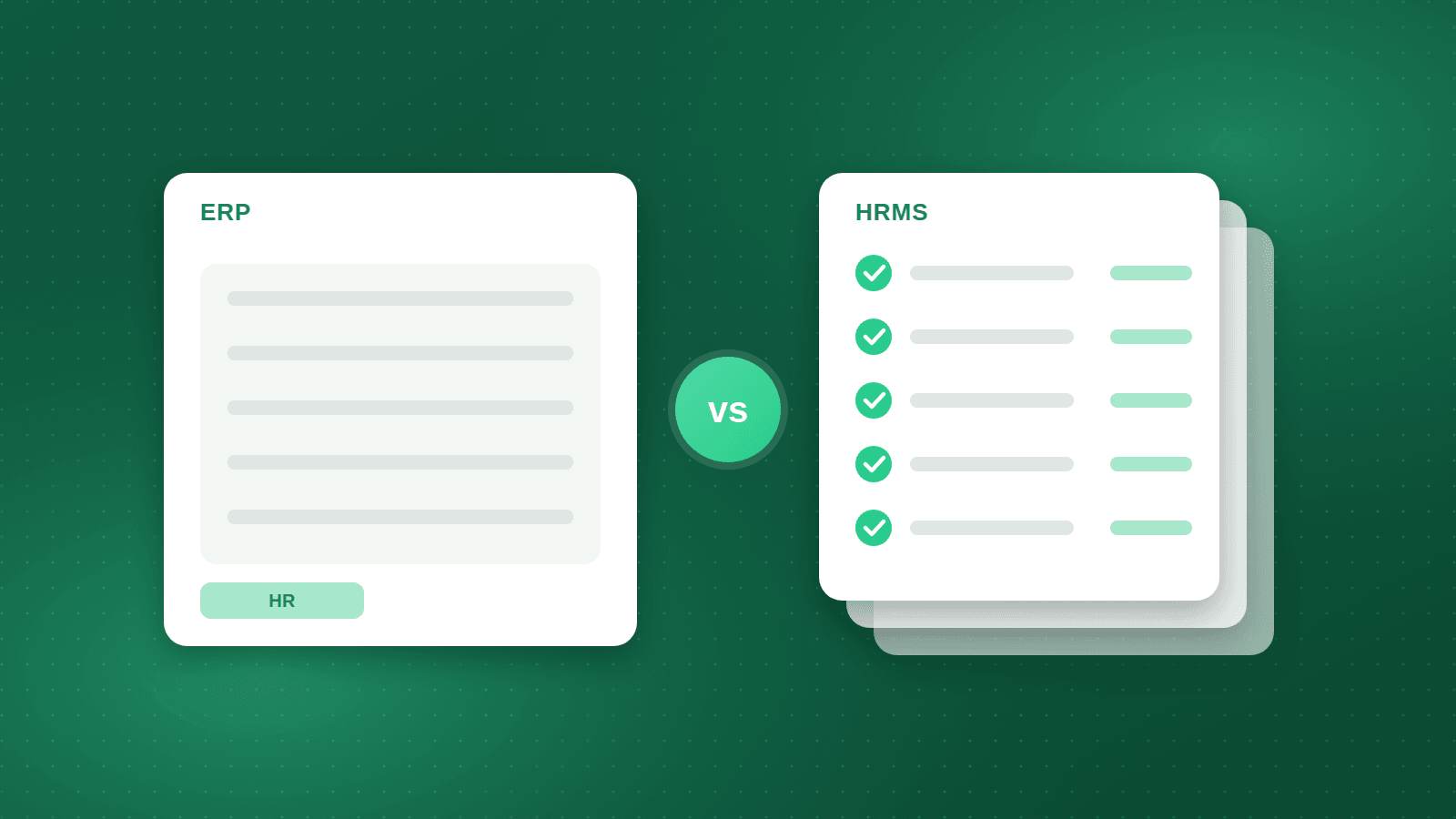
Many large organisations in Egypt and the Gulf run their finance on an ERP and their HR on the ERP's HR module. The logic is sound: one vendor, one database, one support contract, and payroll costs land in the general ledger without an interface. For a while it works, particularly in head-office environments with salaried staff on fixed hours.
Then the organisation grows into shifts, plants, contractors, multiple nationalities and two or three legal entities. HR starts asking the ERP for things it was not built to do: rotating shift calendars, Ramadan hours, geo-fenced mobile punches, Arabic payslips and letters, a mobile app for workers who never sit at a desk. Each request becomes a customisation, and each customisation becomes something to re-test at every ERP upgrade.
This article explains what ERP HR modules genuinely do well, where they run thin, how a dedicated HRMS and an ERP work together in practice, and the criteria a CFO, CIO or HR director can use to decide whether HR needs its own platform.
What ERP HR modules do well
An ERP is built around the general ledger, and its HR module inherits that strength. Payroll costs are allocated to cost centres, projects and legal entities using the same chart of accounts that finance uses for everything else. Accruals for leave and end-of-service can be posted as journals automatically. Headcount budgets sit next to the operating budget, and variance reports compare planned and actual labour cost in one view.
ERP HR modules also handle the basic employee master reasonably: name, identifiers, department, position, salary elements, and a link to the vendor or bank record for payment. For an organisation whose workforce is mostly salaried, office-based and on standard hours, and whose payroll rules are simple, this can be enough for years.
The integration argument is real too. One database means there is no reconciliation between HR headcount and finance headcount. Audit trails are consistent. IT supports one platform. These are not small benefits, and any argument for a separate HRMS has to account for them.
Where ERP HR modules run thin
The trouble starts at the operational edge of HR, which is precisely where most of the headcount lives in manufacturing, retail, logistics, construction, healthcare and facilities management.
Time and attendance is the first gap. Rotating shifts across plants, night premiums, split shifts, automatic overtime and shortage calculation, biometric devices at multiple gates, mobile punching with geo-fencing for field staff, and reduced Ramadan hours are daily operations for HR teams in the region. ERP HR modules typically treat attendance as an import: hours arrive from somewhere else, and the module pays them. The "somewhere else" ends up being a spreadsheet or a third-party device system with its own export.
Local payroll rules are the second gap. Egyptian payroll needs progressive income-tax brackets, social-insurance contributions with an insured-wage floor and ceiling, and, since Labour Law 14/2025 took effect on 1 September 2025, a mandatory annual increment on the social-insured wage, Arabic contracts in four copies and five-year record retention. Saudi payroll needs GOSI contributions that differ by nationality, an end-of-service award on the statutory scale, overtime premiums and bank payment files formatted for the wage-protection process. Global suites deliver localisations for some of this, often late, often partial, and usually requiring partner customisation that the customer then owns.
Employee self-service is the third gap. A workforce that is mostly deskless needs a mobile app in Arabic and English to view payslips, request leave, ask for an HR letter and see approvals. ERP self-service is usually designed for office users with a licence each; extending it to thousands of workers is expensive per seat and awkward on a phone.
Arabic documents are the fourth gap and the one most often underestimated. Contracts, payslips, salary certificates, warning letters and end-of-service settlements must be produced in Arabic, correctly laid out, from the employee record. Many global suites support Arabic data entry but not Arabic document generation with the right templates, so HR ends up maintaining Word templates by hand.
Finally, talent processes such as appraisal cycles, development plans, succession and recruitment pipelines are usually thin or absent in ERP HR modules, or are sold as separate add-ons with their own data model.
The customisation trap
Every gap can be closed with custom development. The ERP partner builds a shift calendar, a tax routine, an Arabic payslip layout, a mobile front end. Individually, each piece works. Collectively they create a version of the ERP that only that organisation runs.
The cost appears at the next upgrade. Each customisation must be re-tested, and some must be rebuilt. Organisations respond by delaying upgrades, which widens the gap between their version and the vendor's supported one. Meanwhile, every change in labour law, tax bracket or insurance ceiling becomes a change request rather than a configuration.
This is the difference between configuration and custom code, and it is the single most important thing to ask about in any evaluation. A dedicated HRMS designed for the region should let HR build salary structures, approval chains, appraisal sheets, letters and forms with built-in designers, and should ship the Egyptian and Saudi statutory rules as maintained engines rather than as project deliverables. Orgarise, for example, is built this way: its payroll engines for Egypt and Saudi/GCC handle tax, social insurance and GOSI, retroactive and net-to-gross calculation and end-of-service, while salary structures, approval chains and documents are configured with designers rather than coded.
The integration pattern that works: HRMS posts to ERP
Choosing a dedicated HRMS does not mean leaving the ERP. In the pattern that most large organisations settle on, the ERP keeps the general ledger, cost centres, budgets and vendor payments, and the HRMS keeps everything about people: the employee file, organisation structure, attendance, payroll calculation, self-service and talent.
The boundary between them is small and well-defined. After each payroll run, the HRMS produces a payroll journal: total salaries, allowances, deductions, employer contributions and accruals, broken down by cost centre and legal entity using the ERP's own chart of accounts. That journal is posted to the ERP. Bank payment files go to the bank from the HRMS. Cost-centre and entity master data flows the other way, from ERP to HRMS, so both systems use the same codes.
This is a much simpler integration than trying to make an ERP HR module do attendance. It changes rarely, it is easy to reconcile because the journal total must equal the payroll total, and it leaves each system doing what it was built for. Finance still sees labour cost by cost centre as soon as payroll closes; HR gains a platform that understands shifts, local law and Arabic documents.
Giza Cable Industries, an Egyptian cable manufacturer established in 1993 with more than 1,000 employees across several plants producing low-voltage to extra-high-voltage cables, runs attendance, payroll and personnel on Orgarise. Attendance from the plant devices feeds overtime and shortages into payroll automatically, and finance receives the payroll result rather than the operational detail. That division of responsibilities is the model to look for.
Decision criteria
Five questions separate organisations that can stay on the ERP HR module from those that need a dedicated HRMS.
First, how much of the workforce works in shifts or in the field? If the answer is more than a small minority, attendance is an HR core process rather than an import, and the ERP module will struggle.
Second, how many statutory changes has payroll absorbed in the last two years, and how were they handled? If each one was a change request to a partner, the organisation is paying for maintenance that a dedicated HRMS would carry as configuration.
Third, can the current system produce an Arabic contract, an Arabic payslip and an Arabic HR letter from the employee record without manual editing? If not, HR is running a parallel document process by hand.
Fourth, what does self-service cost per employee, and what share of employees actually use it? A licence model designed for office users rarely scales to a plant workforce.
Fifth, how long does it take to answer a cross-functional question such as overtime cost by plant for employees hired this year? If the answer involves exports and spreadsheets, the reporting model has already failed.
If two or more of these questions produce uncomfortable answers, the organisation has outgrown the ERP HR module. The decision then is not ERP versus HRMS, but which HRMS integrates cleanly with the ERP that finance will keep.
What to ask a vendor
When evaluating a dedicated HRMS alongside an existing ERP, ask for a demonstration of the journal export in your ERP's format, with your chart of accounts. Ask how cost centres and entities are synchronised. Ask to see the Egyptian tax and insurance calculation, or the Saudi GOSI and end-of-service calculation, on a real payslip in Arabic. Ask how statutory changes are delivered: as a release, or as a project. Ask what the typical go-live is for your modules; for a mid-market implementation, two to six weeks depending on modules and data is a realistic reference point, and anything much longer deserves an explanation.
Ask, too, who will support the system locally, in Arabic, and whether an on-premise option exists if data residency or IT policy requires it. Orgarise is offered as a cloud service priced per employee per month in USD with volume bands, with Enterprise and on-premise editions quoted separately; whichever vendor you evaluate, the deployment and pricing model should be as clear as the functional answers.
Takeaway: let the ERP keep the ledger and give HR its own platform
The ERP HR module is the right choice while the workforce is simple and the payroll rules are few. Once shifts, local statutory engines, Arabic documents and a deskless workforce enter the picture, the module stops being the cheap option and starts being the expensive one, paid for in customisation and delayed upgrades. The mature pattern is clear: the ERP keeps the ledger and cost centres, the HRMS owns the employee lifecycle, and a payroll journal connects the two. Decide on that boundary first, and the platform choice follows.
Frequently asked questions
Do we have to replace our ERP to adopt a dedicated HRMS?
No. The ERP keeps the general ledger, cost centres and budgets. The HRMS runs the employee lifecycle and posts a payroll journal to the ERP after each pay run, while cost-centre master data flows back from the ERP so both systems use the same codes.
Won't two systems create more reconciliation work?
The boundary is a single journal per payroll run, so reconciliation is a check that the journal total equals the payroll total. That is far less work than reconciling attendance imports, manual overtime sheets and hand-edited Arabic documents around an ERP HR module.
How are statutory changes handled in a dedicated HRMS?
They should arrive as maintained releases of the payroll engine, not as custom projects. Ask any vendor how the most recent Egyptian or Saudi change was delivered to existing customers and how long it took to reach them.
When is the ERP HR module enough?
When most employees are salaried office staff on standard hours, payroll rules are simple, Arabic document needs are limited and self-service is used by a small licensed population. Revisit the decision when shifts, multiple entities or a deskless workforce appear.
Giza Cable Industries — 1,000+ employees
A leading Middle-East cable manufacturer unifies attendance and payroll across its plants on one HR platform.
1,000+
Employees on one platform
LV–EHV
Production lines, low to extra-high voltage
Multi-site
Plants on one attendance calendar
See how Orgarise handles this
A 30-minute demo on your own scenario, in Arabic or English.